Gripping a Golf Club Correctly
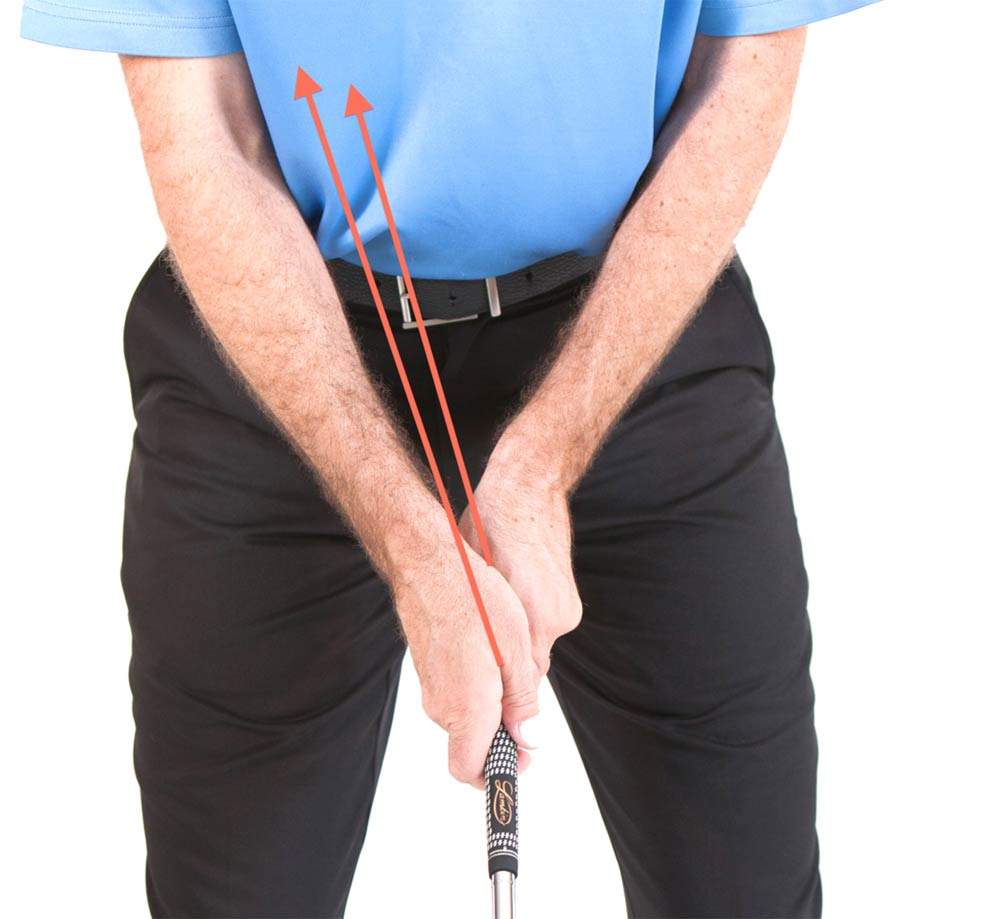

To me, a proper grip is one of the most important factors when developing a repeatable and reliable golf game. Directionally speaking, I define an effective grip as one that will return the club face back to its starting position, and here’s the key, without manipulation. For example, if we start with the club face directed at the target, it should return to that position at impact without flipping, rolling wrists, or other compensations. From a power standpoint, an effective grip should allow for sufficient club head speed, leverage, and efficiency of contact with minimal effort.
Before getting into details, we should go over a general concept about hand placement and grip. How we place our hands on the handle, from a rotational standpoint, directly influences how the club face will return back to the ball. In theory, if we set up with a neutral grip position, when we make our golf swing, the club face will return back to the position in which it started. If we grip the club with our hands rotated too far to the left around the shaft, when we make our golf swing, our hands return to a neutral position and the club face returns to the ball in an open faced position. Conversely, if we start with a grip that is rotated too far to the right, our club face will return back to the ball closed or facing to the left. This important concept is often confused, but understanding this simple relationship can really help your game. If we find that the club face is returning to the ball either open or closed, we can rotate our hands on the handle accordingly and eventually hone in on a neutral position which returns the club back to square more repeatedly.
Types of Grips
Golf grips today are generally made of rubber and sometimes leather. Some types of grips have “cords” embedded in them or tacky materials on the surface designed to increase a player’s hold on the club. Some grips have what is called a “rib” or “spine”. This is a thicker area usually located lengthwise along the bottom side of the grip. This aids the player in aligning the clubface more consistently. All of these features are purely a matter of preference. All players should choose a grip that feels right to them.
Grip Caps and Hand Placement
All grips have a cap on the butt end of the club, or at least a ring used to indicate this cap. This tells the player exactly where the shaft ends. Above this line is grip material only. When gripping the golf club, the player’s top hand should never contact the club above this ring. This will allow for the maximum surface area of the player’s hands to contact the club itself, increasing consistency and control.
Grip Size
Grip size is the next important factor when determining the correct golf grip. Grip size is a measure of the circumference of the grip and can be adjusted by changing the type of grip used and/or the number of wraps of adhesive tape applied to the shaft under the grip. The recommended grip size is achieved when the player’s hands are properly placed on the club and the fingertips of the top hand gently touch the base of the thumb. If the grip size is too small, the fingers will gouge into the base of the thumb and will feel uncomfortable to the player. This will also encourage increased “hand action” during the swing and diminishes control of the clubhead in many cases. If grip size is too large, the top hand will not reach around the circumference of the grip and the fingers will not contact the base of the thumb. In this case, the player’s control of the golf club will be reduced and the proper release of the clubhead through impact may be inhibited. Grip type and grip size are crucial aspects of every golf club in the bag. Each of these factors directly affect the player’s comfort and performance.
Grip Pressure
Grip pressure is the next major concern when holding and swinging a golf club. Grip pressure is how tightly a player squeezes the golf club before and during the golf swing. On a scale of 1 – 10 (1=club sliding out of your hand, 10=white knuckled, tightest grip possible), grip pressure should be about a “3”. Hands, wrists, arms, and shoulders should all remain relaxed and fluid throughout the golf swing. The player should hold the golf club only tight enough to sufficiently control its movement. Take note that a grip pressure level of “3” is maintained throughout the swing. Many players are relaxed in the setup position, but strangle the club during the swing. This will take a conscious effort at first, especially if the player is nervous or under pressure.
Grip Fitting and its Effect on Grip Pressure
Going back to grip type and size, these factors certainly affect the amount of grip pressure that is needed to maintain control of the golf club throughout the swing. Because of the forces involved in a golf swing, a grip that is the correct size and style for the player will allow them to apply the minimal amount of grip pressure throughout the movement. Muscles will remain relaxed, swing speed maximized, and minimal compensations made. These are all keys to effective ball striking. On the other hand, old, un-maintained, and improperly sized grips will require additional grip pressure on the player’s part to maintain control throughout the golf swing. Muscles slow down when they become tense. This will reduce the natural flow of the golf swing.Before gripping and swinging the golf club, a soft grip pressure must be on the player’s metal checklist. Reducing tension is imperative to producing a rhythmic, repeatable golf swing-especially under pressure. This is a major reason why better players waggle the clubhead or exhale deeply before starting their golf swing.
Top Hand Positioning
There are many different ways to describe the positioning of the hands when gripping a golf club. Relate to the ones that best suit your learning style. Begin with the top hand (left hand for right-handed golfers). In general, the grip must be placed primarily in the fingers and not set deep into the palm of the hand. The fingers wrap counterclockwise around the underside of the club. The entire base of the left hand should rest mostly on the top of the shaft. If done correctly, you should be able to remove all fingers except the forefinger from the club while holding the shaft horizontal to the ground. The weight of the clubhead will leverage off the forefinger (under the shaft) and against the base of the hand (on top of the shaft). The tendency for beginners is failing to place the base of their hand properly on top of the shaft. This test will expose this problem. Later, this hand position will be vital when supporting the club at the top of the golf swing, and also when attempting to square the clubface at impact.
Top Hand Thumb Placement
Another indication of the proper placement of the left hand is the left thumb. The thumb should be directed straight down the shaft toward the clubhead. However, the thumb is not directly on top of the shaft, nor is it entirely on the right side of the shaft. It should point downward, parallel to the shaft, but in a position right-of-center.
Knuckle Rule in the Address Position
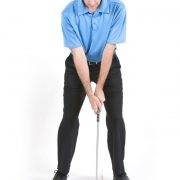
The last indicator for top hand position is the knuckle rule. Set the clubhead down in a square position directly in front of you with the butt directed at your zipper. Without leaning to either side, looking straight down at your hands, you should be able to see 2 –3 knuckles on the back of your left hand. If you cannot see at least 2 knuckles, then your left hand must rotate clockwise around the grip until the correct number of knuckles is visible.Positioning of the top hand in the grip is probably the most important part of gripping a golf club. It is recommended that you practice this procedure regularly so it becomes permanently and properly engrained in your muscle memory. This can be done at home in front of a mirror or even while watching television.
Bottom Hand Positioning
The next step in the gripping process is the placement and positioning of the lower (right) hand on the club. The positioning of the top hand directly influences the location of the bottom hand. This is because the thumb of the top hand (straight down the right-center of the shaft) should fit nicely in to the lifeline of the right hand. Once this lifeline covers the thumb on the shaft, there is 1 of 3 typical ways to establish a “connection” between the two hands:
Baseball Grip: The first grip is known as the baseball grip or the ten-finger grip. This form is popular among beginners, junior golfers, and many women. All four fingers of the bottom hand wrap counterclockwise around the grip of the club. This provides the maximum grip-hand contact with the club, but also the least amount of unification between the two hands.
Interlocking Grip: Next is the interlocking grip. Again, the lifeline covers the thumb, and all the fingers of the bottom hand wrap around the underside of the club. The difference is that the pinky of the bottom hand and forefinger of the top hand lock together. This brings the hands closer together and allows them to act as a single unit in the golf swing. Players with smaller hands typically use this grip.
Vardon Grip: Lastly is the grip known as the overlap or the Vardon grip. This is the most popular grip used on the PGA Tour and is favored by better players, particularly those with larger hands. This grip is the same as the interlock, except the pinky of the lower hand is place on top of the upper hand, usually between the middle and forefingers. It is important to note the position of the ring finger of the lower hand with this grip. The tendency is for it to ride up onto the forefinger of the top hand, but it must remain on the shaft.
Once the connection between the top and bottom hands has been set, the right hand should rest on the shaft such that the club is held well out into the fingers. The palm of the right hand should not contact the shaft itself for the most part. The right thumb must be in a position where the shaft will not be allowed to slide up and down between the right thumb and forefinger. It should, however, be placed down the left-center of the shaft in order to provide balance with the left thumb on the right-center of the shaft.These are the fundamentals to a sound golf grip. The hands should not move along or around the shaft of the golf club throughout the swing. As mentioned above, grip pressure is as light as possible and with practice, placement of the hands will become second nature.
In summary, a proper grip will achieve maximum club head speed, leverage, and control with minimal compensation in your golf swing. How we place our hands on the handle of the club from a rotational standpoint directly influences how the club face will return to the ball at impact. The top hand is most critical, be sure that your left thumb goes down the right center of the shaft and the base of your left hand sits on top of the grip. You should be able to leverage the club with just one finger of your left hand. Which ever grip you choose, your hands need to be working together as a unit, with palms facing one another. And lastly, maintaining a soft grip pressure throughout your golf swing will contribute to more club head speed, distance, and consistency.